



Undergraduate programs
Undergraduate studies at the Ford School are based in social science disciplines such as sociology, economics, and political science-layered with analysis of and engagement with real-world public challenges.
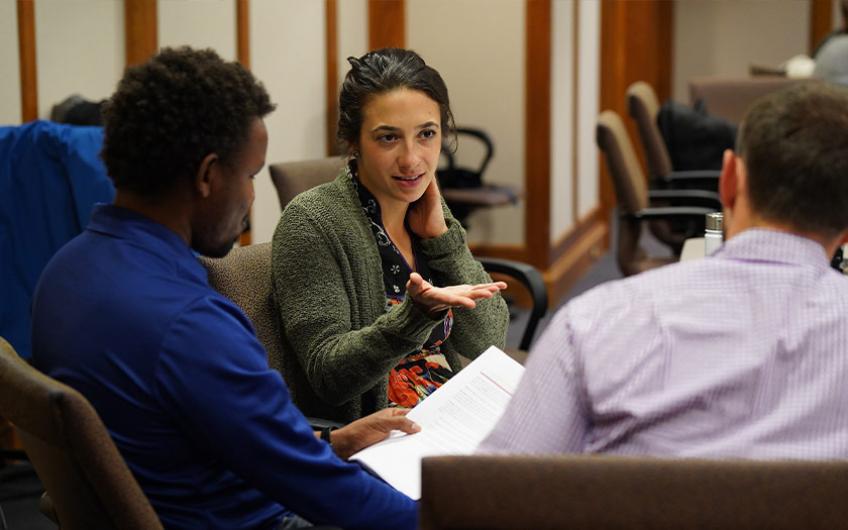
Our coursework emphasizes teamwork, writing, analysis, and class participation. Ford School undergraduate students become full members of our close-knit community, and work in small groups with some of the University of Michigan's top faculty members.
At a glance
Bachelor of Arts in Public Policy | Minor in Public Policy | |
|---|---|---|
Description | Provides U-M students with knowledge and skills to analyze policy problems, understand the stakes, and create viable solutions. | Layer a U-M degree—engineering, sociology, business, or organizational studies, for example—with perspectives from the lens of public policy. |
Public Policy credits completed in residence | 30 | 8 (Fall 2026 admits) or 12 (Fall 2025 admits) |
Additional coursework (may be completed outside Ford) | STATS 250 or SOC 210: Introduction to Statistics (4 credits); Coursework in student-declared focus area (12 credits) | ECON 101 (Fall 2026 admits only) and coursework in Public Policy or approved non-Public Policy electives (6 credits for Fall 2026 admits, or 3 credits for Fall 2025 admits) |
Total required credits to complete Ford curriculum | 46 | 15 credits for students admitted for Fall 2025 and 17 credits for students admitted for Fall 2026 and beyond |
Minimum credits required to reach degree completion | 120 (includes total required credits to complete Ford curriculum) | Determined by a student's enrollment (Ex. LSA BA 120; ENGIN ME 128) |
Number of students per cohort | 100 | 40 |
More information
For prospective students, email the admissions team at [email protected].
Have any questions?

Contact